How much weight will I lose? How much weight should I lose? I was told I should lose 40 pounds. I want to fit into my clothes. I know when I was a certain weight I felt great.
What are your thoughts about your weight loss expectations? Many people beginning a weight management effort have thoughts about a target or goal weight, and thoughts about what would be their ideal weight.
Weight is not a behaviour
Would you be surprised to know that your weight is considered something you do not have control over? Put simply, weight is not a behaviour. It is not something you do.
Consider for a moment the things that affect your weight that you do have control and influence over. When you are eating as healthily and moderately as you can while still enjoying your life in a sustainable way, and when you are as active as you can be in a sustainable way, exactly where you land with your weight is determined by an appetite system that is hundreds of thousands of years old.
Another name for your appetite system is your weight regulation system. It comprises three levels of your brain. As you lose weight, the fat loss is expertly recognized by the homeostatic system in your hypothalamus — the biological defence against fat loss. In response to weight loss, the homeostatic system initiates changes that favour weight regain: your metabolic rate decreases, and the motivation system — the source of wanting — strengthens. These changes are the reason for the characteristic shape of all successful weight loss efforts.
The shape of human weight loss
Almost every successful weight loss takes the same characteristic shape. It was described in a landmark review paper by Kevin Hall and Scott Kahan,1 and the ideas below are drawn from the process it lays out — a steady behavioural effort meeting a biological response that progressively pushes back.
Here is the whole story in four movements.
As you lose fat, your appetite rises. Your brain recognizes the loss and defends against it — appetite climbs, and, to a lesser degree, your metabolic rate dips. The further you get from your highest weight, the harder your brain pushes.
So your intake creeps up — often without you noticing. You began by eating meaningfully less than your brain was asking for. As the weeks pass, you are eating a little more, then a little more again. It rarely feels like a decision. It is appetite quietly winning back ground.
When intake catches up to what you burn, weight loss stops. For someone losing weight without medication, that is often around six to nine months; on an obesity medication during dose escalation, the rising dose keeps appetite down and the timeline stretches to roughly twelve to fifteen months. Either way, the point where calories in meet calories out is the plateau.
And here is the part that matters most: your effort never changed. Picture the gap between what your brain is asking for and what you actually eat. At week one that gap was, say, 800 calories. At the plateau — months later, eating noticeably more — the gap is still about 800 calories. Your appetite went up and your intake went up together, at the same rate. The gap is the effort, and it held constant the entire time.
The skill is the effort, and you practise it from the beginning
Near the plateau, you may find yourself saying: I'm really still eating the same as when I started, and my weight loss is slowing. And you may authentically feel that you are eating the same — because you are extending the same level of effort. The effort feels the same because the effort is the same. Yes — the calorie intake has gone up. So has appetite. They have gone up together, at the same rate. The 800-calorie gap between what the brain is asking for and what is being eaten — that gap is what has stayed constant from week one to the plateau. The gap is the effort. The effort is what you feel. And you are right.
This is also why there is no point in excessive effort. If you practise an effort level you cannot sustain long-term, you are practising a skill you will not need — a skill that is only temporary: a mildly or moderately unsustainable level of effort. This is really what so much of dieting has been: temporary means to an end. Do this now, and later things will be better.
There is a mythology out in the diet world that the weight loss portion and the weight maintenance portion are different. The refrain would go: first you will be in the weight loss phase, and then when you get to your target weight, you will go onto the maintenance phase, which is different — or we add things. Quite literally, the individual who loses weight that way is spending much of their time on a skill they will never use.
A real predictor of long-term success is the time spent practising the very level of effort that you can sustain long-term. That is the skill: to find it, to feel confident with it, to know that it supports you. And then to understand that that level of effort does not perpetually result in weight loss — eventually intake matches energy expenditure, and that is the plateau. But you have arrived with a level of effort that you have studied, practised, and grown confident in. The transition from weight loss to maintenance is not a transition at all. The skill is the same skill.
Victim of your own success
A useful reframe captures what the biology described above means at the level of lived experience. As fat loss continues, the brain pushes harder against it. Appetite re-strengthens. High-risk times become more intense. The work feels harder precisely because it is working — the brain's defensive response is calibrated to the success of the weight loss.
In a real sense, someone losing weight successfully is a victim of their own success. The reframe matters most in moments that look like failure — an off-track evening, a weigh-in not in one's favour, a plateau, a stretch where wanting feels suddenly stronger. These are not signs of effort failing. They are signs of biology doing what biology does. The same logic applies in conversations with your prescriber about medication: when a previously effective dose seems to be working less well, the most common reason is the brain re-strengthening appetite as fat loss continues.
Best weight, defined
Simply, your BEST WEIGHT is the weight you land at — living your most sustainable, livable, enjoyable lifestyle, still keeping a loyalty to the things you value and enjoy, and, most importantly, as described above, at a level of effort you can really maintain long term.
Something else follows from this — and it may be the most clinically important point in the module. Once the predetermined target is set aside, what matters is how satisfied you are with where you actually land. Satisfaction with your best weight is a better predictor of staying there than how close you got to a theoretical goal. The people who maintain weight loss over the long run are not the people who hit a number they picked. They are the people who arrive at a weight they did not pick, that comes from a life they can sustain, and that they are satisfied with. Satisfaction is the maintenance mechanism. The behavioural work of this module — letting your brain and body tell you where your honest effort lands you — is, in large part, the work that produces it.
Behavioural best weight, and behavioural-plus-medication best weight
It helps to think of best weight in two categories. There is the best weight you reach with a comprehensive behavioural program alone. And there is a lower best weight available when an obesity medication is added to that same behavioural work — the medication reaching the parts of the brain you cannot, so appetite and wanting settle lower.
If further weight loss would improve your health and quality of life but eating less is not something you can realistically sustain, adding a safe and effective obesity medication is a sensible — and increasingly common — option for anyone who qualifies and is interested.
Where you are, in numbers — the percentage from your heaviest
The conversation about best weight is, in part, a conversation about where you are. The biology described in this module plays out at a magnitude that varies from one person to the next — genetics determines how strongly the brain defends, response to any medication is individual, and the lifestyle you can sustainably maintain is personal. Within that variability, however, there is a meaningful anchor: the percentage of your body weight you are down from your heaviest. This number is not a scorecard. It is evidence — about how strongly your brain has been defending, and about where you sit relative to what a medication produces, on average, at your dose.
The bookmark — why your highest weight is the reference
The reference point is your highest non-pregnancy weight — your all-time high. It can feel like an unfair reference: a weight you were at briefly, during a particularly difficult stretch, that does not feel like you. But the theory goes that your brain has bookmarked that highest weight, and the further you get from it, the more strongly it pushes back. The bookmark is not symbolic; it is the mechanism by which continued weight loss generates increasing biological pressure.
There is a second reason the highest weight matters: you were able to reach it. Your brain did not stop you. That tells us about your genetic ceiling — the point at which your homeostatic system was finally willing to intervene.
Real-world averages, dose by dose
If you are on an obesity medication, each maintenance dose has a real-world average percentage-from-heaviest. These averages come from patients whose real lives interfered with perfect execution — missed doses, life-stress interruptions, other medications that can promote appetite or weight (certain antidepressants, insulins, beta blockers, steroids). All of that is built into the average, not subtracted from it. If your adherence has been imperfect, you are not below average for the imperfection — you are inside the population the average describes. The dose-by-dose numbers are laid out in the Dose-by-dose averages on the Medication page.
When your number is at or above the average
It might not stand out in your thinking, but if you are down by a percentage at or above the average for your dose, you are on track — if anything, advanced. This matters most in the moments that feel like failure: the slowing of weight loss, a stretch where your weight has barely moved, the worry that the medication is no longer working. These moments often coincide with being well within or above your dose's average response, and the number counters that emotional reading.
Being on track is never down to a single source. Some combination of your response to the medication, your motivation, your focus, your self-regulation skills, your behavioural work, or simply where your individual biology landed — any of these may be contributing.
When your number is below the average
Then the conversation returns to the foundation. These numbers are averages; everyone is different. Where your weight lands is not something you control — a complex appetite system, genetic vulnerability, and individual variation in response to medication all operate under the radar, in ways unavailable to you.
The mission is unchanged: to find the least amount of calories you can take in while still enjoying your life — keeping a loyalty to food, friends, socialization, celebration, travel — at a level of effort you could really keep long-term. That is the skill. And then the hard part: doing all of that and standing back, letting your brain and body tell you where it lands. That is your best weight. It is a hard message, and it is the honest one — and it is the same path whether your number sits above the average or below it.
The number is evidence, not the goal
The percentage belongs in conversations about expectations — how to think about the rate of weight loss, where it is realistic to go from here, and how to read the slowing of weight loss without reading it as failure — always within the position that the weight you land at is not something you control. One thing this framework deliberately does not include is a timeline. How long it takes to reach a plateau on any dose depends on the dose, the rate of escalation, your individual response, and the life it is all happening in. Everyone is on their own journey and their own schedule.
And if weighing yourself is emotionally loaded — the classic question of should I be weighing myself at all is a real one — the framework still works in broad strokes rather than specific numbers. You are never required to track a number for it to help you.
Feeling your best — a value, not a number
The percentage-from-heaviest conversation above is about where you are. The dose-by-dose averages are about where you might go. Both are conversations about the number. There is a third part of the best-weight conversation that is not about the number at all, and it tends to surface in a particular moment: when a feeling gets attached to a specific weight. I'll feel my best at 190. The number arrives welded to a state — feeling your best, feeling like yourself, the way things were at some earlier time.
The move is not to argue the number down, and not to set the feeling aside. It is to take feeling your best seriously and ask what it is made of — because feeling your best points at a value: an intrinsic motivation, the root of what feeling your best actually means to you. Managing weight over the long term is work — the work of managing a chronic disease — and humans are capable of hard work long into the future only when it is in the direction of something that is really important to them. Values are that direction. They are not a number; they are a direction, not a destination — not a flag you plant to say you have arrived. (The work of clarifying them is covered in the Values module.)
When the value is clarified — I want to be in the direction where my weight and my health are least preventing me from being active and engaged with the people and experiences that matter to me, long into the future — and you ask yourself does that sound important to me?, the answer is usually some version of yes — that's everything. The clarified value then does two things at once. It is a source of motivation for the daily work. And it is the balance to the weight number itself — the number you have already been invited to consider as something you do not control. A clarified value holds elements of your weight, and of your fitness and activity — but nowhere in it is there a number.
The health benefits of weight loss happen earlier than you think
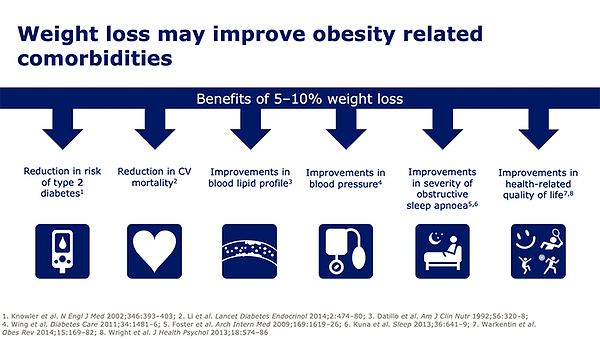
A sustained weight loss of as little as 5–15% of body weight results in clinically significant health benefits. These benefits include substantial reductions in deaths from heart disease and stroke, reductions in heart disease risk factors (high blood pressure and high cholesterol), improvement or remission of diabetes, and improvements in conditions such as sleep apnea, fatty liver, and osteoarthritis. A 5–15% body weight loss also importantly results in significant improvements in health-related quality of life. Larger percentages of weight loss have been shown to reduce the risks of a series of 11 cancers.
Will losing weight make me feel better about my body?
A common goal of weight loss is to feel better about how one looks. A common expectation is that weight loss always results in improved body satisfaction, and that the more weight that is lost, the happier one will feel. Would you be surprised to know that this is regularly untrue?
Simply put, how you feel about yourself can be inconsistent with how you look. Many people who are thin or of average weight dislike their appearance, or are dissatisfied with certain parts of their body. Many people who are heavy feel attractive and comfortable with their appearance.
The subject of body dissatisfaction, and the work involved in addressing it, is covered more fully in the Resilience module. Briefly: body satisfaction is more about the beliefs you hold about your body than it is about the size of your body. These beliefs are shaped primarily by external messages received about body shape — from a weight-obsessed culture, from family, coaches, and friends. Body satisfaction is about being more accepting and less critical of how you look. Those who have or achieve body satisfaction will describe that some aspects of their appearance they like and some they tolerate — but most importantly, they spend minimal time focused on their image, and are freer to focus on other things.
Read more in the Resilience module →
- Hall KD, Kahan S. Maintenance of lost weight and long-term management of obesity. Medical Clinics of North America. 2018. View source ↩